Greece says its recession is deepening and will present “alarming”
information about the state of the country's economy this week to
international auditors in a new effort to ease the terms of the
government's latest bailout.
A government spokesman described the economic data as “astounding”
in a television interview Tuesday, but gave no details. He said the
information “shows beyond any doubt” that the austerity measures
demanded by Greece's creditors are hurting the country's economy rather
than helping it.
Deputy Finance Minister Christos Staikouras said the Greek economy,
in its fifth year of a recession, would contract 6.7 percent this year
compared to a previous forecast of 4.5 percent. At last count, in March,
more than one of every five Greek workers was unemployed.
Debt inspectors from the European Commission, the European Central
Bank and the International Monetary Fund are set later this week to take
a new look at the precarious state of the government's finances. The
auditors are in Athens to check on the limited progress the government
has made in imposing spending cuts it agreed to earlier this year when
it secured a new $168 billion bailout. It was the country's second
rescue package in two years.
But even before the auditors take a look at the government's
financial ledgers, political leaders in Greece's new coalition
government are calling for at least a two-year extension to the 2014
mandate for the government to produce a budget surplus. But one European
Central Bank official on Monday said Greece should not waste time
seeking to ease the terms of the bailout and instead should push to
carry out the austerity spending plan calling for pension and wage cuts
and elimination of thousands of government jobs.
On Tuesday, a European Commission official, Horst Reichenbach, said
Greece needs to start paying back the more than $7 billion it owes to
suppliers, such as pharmaceutical and construction companies, to pump
more money into the country's beleaguered economy.
“It would be very difficult to really improve the situation of the
Greek economy, even with these reforms, if the very difficult situation
of access to finance is not tackled. And here, the first step is to pay
the arrears which have accumulated and obviously also the (valued added
tax) contributions, which in particular for the export industry are
accumulating and raising difficulties.''
If you have any money and you want to understand the lies that “your” government tells you with statistics, subscribe to John Williams shadowstats.com.
John Williams is the best and utterly truthful statistician that we the people have.
The charts below come from John Williams Hyperinflation Report, January 25, 2012. The commentary is supplied by me.
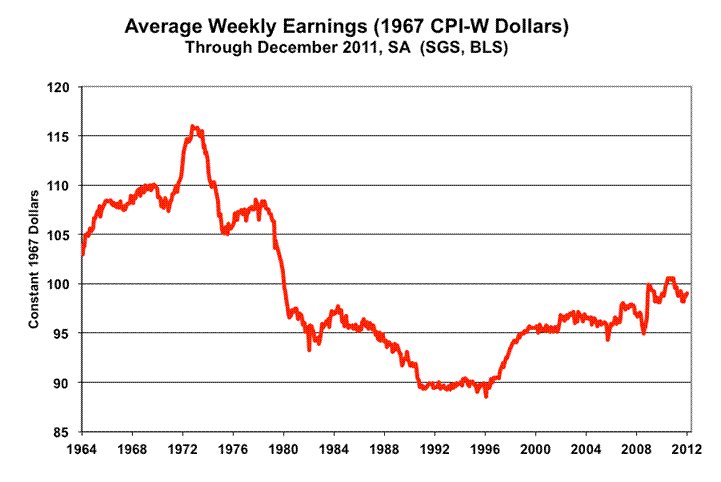
Here is the chart of real average weekly earnings deflated by the US government’s own measure of inflation, which as I pointed out in my recent column, Economics Lesson 1, understates true inflation.
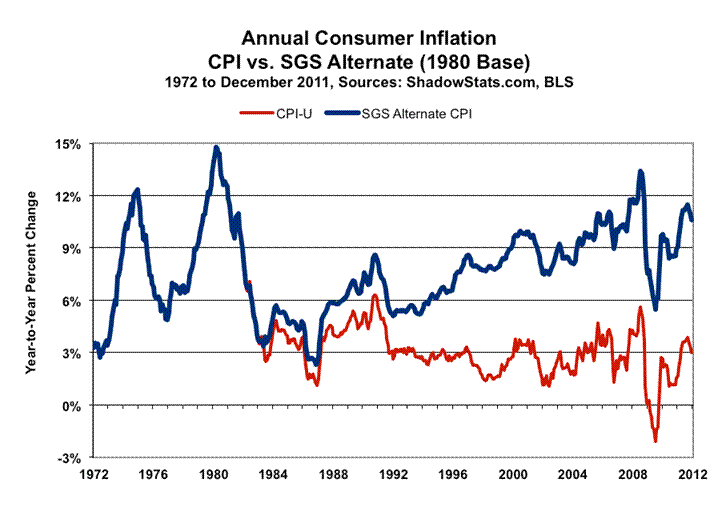
This chart (below) shows the behavior of inflation as measured by “our” government’s official measure, CPI-U (bottom line) and John Williams measure which uses the official methodology of when I was Assistant Secretary of the US Treasury. The gap between the top and bottom lines represents the amount of money that was due to Social Security recipients and others whose income was indexed to inflation that was diverted by the government to wars, police state, and bankers’ bailouts.
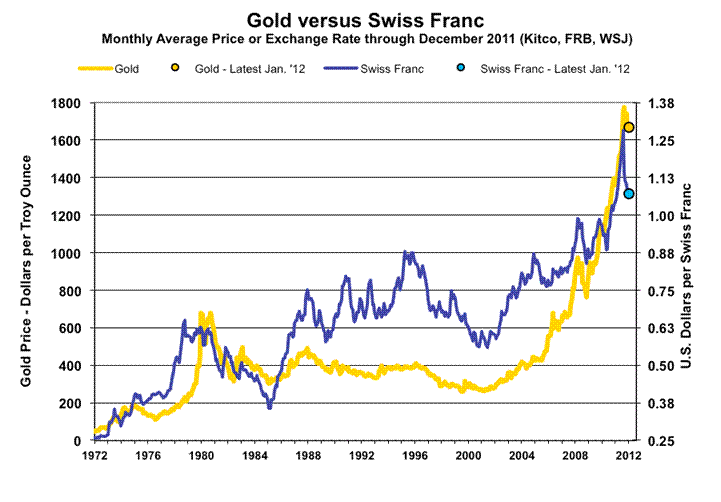
This next chart shows the gains that gold and the Swiss franc have made against the US dollar. The Swiss franc is the top line and gold is the bottom. When gold and the Swiss franc rise, the dollar is falling. Notice that during President Reagan’s first term, when I was in the Treasury, gold and the Swiss franc dropped, that is, the dollar rose in purchasing power. Obviously, the supply-side policy that Reagan implemented strengthened the US dollar. It was only with the advent of the Bush policy of endless trillion dollar wars, reaffirmed by Obama, that the US dollar and economy collapsed relative to gold and hard currencies.
The recent drop in the Swiss franc is due to the Swiss government announcing that the country’s exports could not tolerate any further run up in the franc’s value, and that the Swiss central bank would print new francs to accommodate future inflows of dollars and euros. In other words, Switzerland was forced to import US inflation in order to protect its exports.
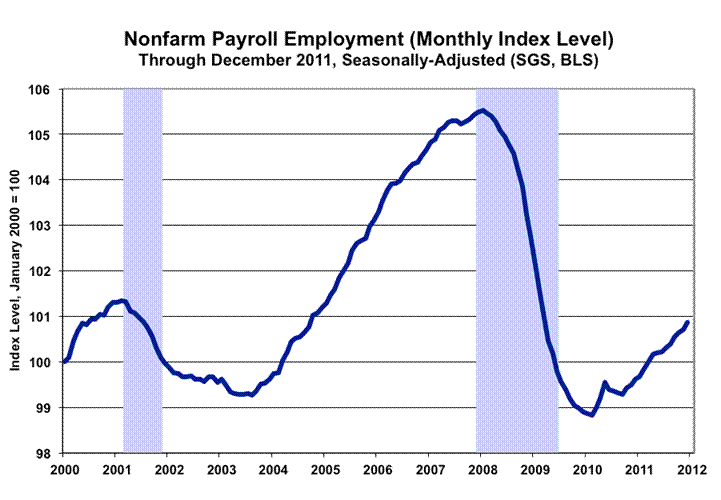
Here is nonfarm payroll employment. As you can see, the US economy has been in recession for four years despite the easiest monetary policy and largest government deficits in US history.
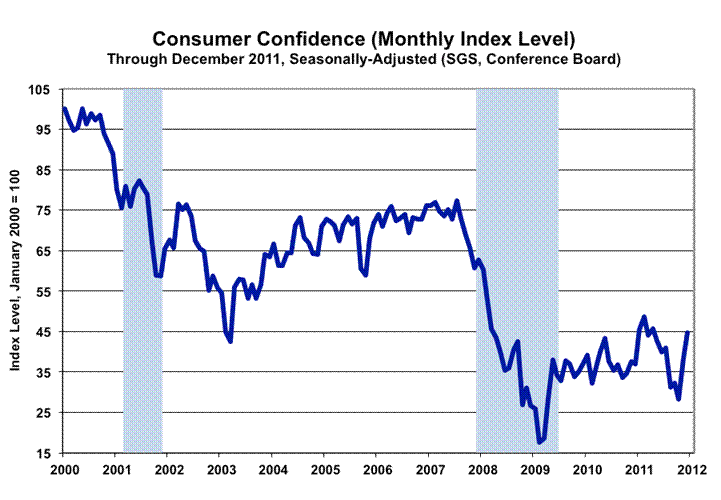
Here is consumer confidence. Do you see a recovery despite all the recovery hype from politicians and the financial media?
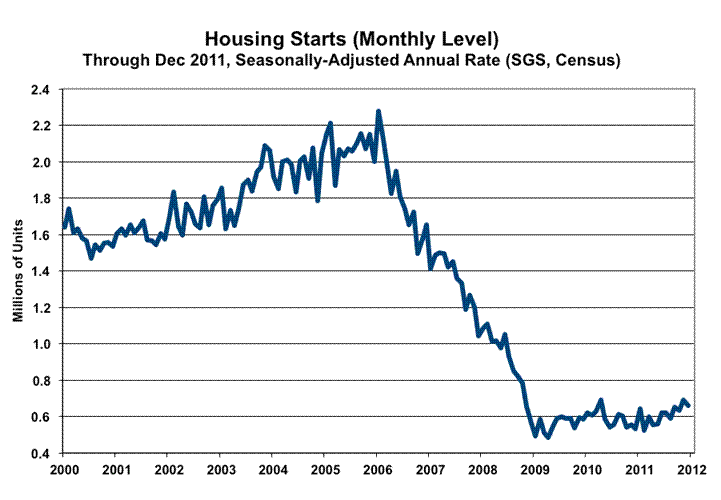
Here is housing starts. Do you see a recovery?
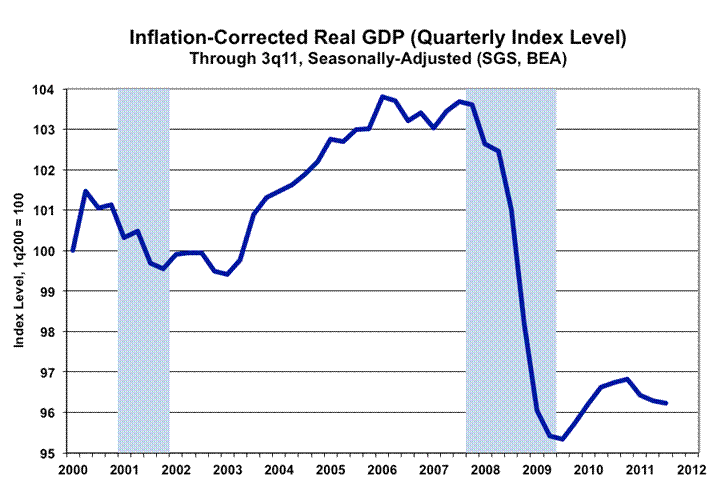
Here is real GDP deflated according to the methodology used when I was in the US Treasury.
Here is real retail sales deflated by the traditional, as contrasted with the current, substitution-based, measure of inflation.
These graphs courtesy of John Williams make it completely clear that there is no economic recovery. In place of recovery, we have hype from politicians, Wall Street, and the presstitute media. The “recovery” is no more real than Iraqi “weapons of mass destruction” or Iranian “nukes” or the Obama regime’s phony story of assassinating last year an undefended Osama bin Laden, allegedly the mastermind of Islamic terrorism, left by al Qaeda to the mercy of a US Seal team, a man who was widely reported to have died from renal failure in December 2001, a man who denied any responsibility for 9/11.
A government and media that will deceive you about simple things such as inflation, unemployment, and GDP growth, will lie to you about everything. Paul Craig Roberts was Assistant Secretary of the Treasury for Economic Policy and associate editor of the Wall Street Journal. He was columnist for Business Week, Scripps Howard News Service, and Creators Syndicate. He has had many university appointments. His internet columns have attracted a worldwide following. Visit his website at http://www.paulcraigroberts.org
We are trying to figure out the best way to describe the banking and oil sanctions against Iran, which are blatant acts of war. Just look back in history at similar situations and you will see what we are referring too. It is simple incompetence or is the allied plan a false flag feint in order to distract attention away from debt problems?
A month ago when the US was trying to terrorize Syria and Iran with oil and banking sanctions we said they did not have a chance of winning. Iran’s nations that are friendlies, such as China, India and Russia are major nations that will assist in the circumvention of some 70% of those sanctions. As we predicted all the excitement in the Straight of Hormuz was just that, another distraction. This week the USS Abraham Lincoln, an aircraft Carrier, went through the Straight, which tells us as we said earlier, it was all just a game. That relieved pressure of financial markets in Europe, the UK and US.
Most people forget an agreement has been in place for more than a year between Russia and China, so the precedent has been set and it works. To simplify things India wants to use gold in exchange for oil, a very simple and novel idea.
What does all this add up too? The basic common denominator is a growing existence of the US dollar and of the world financial system. What Washington has done has expedited the end of the US dollar as the world’s reserve currency. Worse yet for the dollar deals like this are in the works all over Asia. Alliances are forming as we speak and it is only a matter of time before it happens. We believe this will take place over the next two years, accompanied by higher interest rates. These countries are proceeding at their own pace and will soon have major agreements in place.
The movement toward an alternative trade, a monetary and financial system is underway and the US is trying to force dollar usage on everyone, like it or not. If the US doesn’t come up with an alternative soon they may be ejected out of world trade, because few will want their currency. These engineered events just make the US look weaker in the long run. Foreigners are already euro sellers and T-bill buyers.
Again, we return to the unnatural and unbalanced trade situation between Germany and the remainder of the EU. The gap in competitiveness between the industrial north and the south is enormous.
If the EU and euro zone had been properly set up as a political and fiscal union that might have succeeded. There was no political union – only a financial and trade union, which we wrote in 1992, could never work and it did not work as we are observing. What this has turned out to be and we predicted it, and that is an unending transfer of wealth from the north to the south. If you look at the pluses and minuses Germany should exit the euro zone. The euro has been used to stay close to France due to the experiences of the past. That is very difficult because the German culture is much different than that of other countries like France, England or the US. You have to live there in those countries and speak their languages to truly understand how they think and why they are the culture that they are.
A d v e r t i s e m e n t
In addition to culture problems we have a group of Illuminists, who always happen to be appointed to the positions of power to further the aims and goals of world government. Today Mr. Draghi at the ECB is a prime example. All that was accomplished by previous ECB management has been cast to the 4-winds – a complete turnaround by following orders from London and NYC to crank up money and credit creation. This obviously is the only way these elitists know how to temporarily make an economy run. All they have done has saved the financial sector and done little for economic recovery. Why should anyone expect any different result?
Italy is buried in debt, as is Spain and they are uncompetitive. Spain’s real estate collapse is worse then that of the US. In Spain you also have to too big to fail syndrome, which means bank nationalization in both countries, as in England and in other various European countries. Spain has to go bankrupt. Real estate has not as yet hit a bottom. Spain and Italy are already caught up in a deflationary debt spiral and will eventually have to default and leave the euro. There was no vigilance. Few paid attention to their performance and plight, and now you are seeing the result of that.
We are now faced with tremendous deficit spending, that money and credit being supplied by the Fed, which, of course, will never be repaid.
While euro squabbles over the euro and sovereign debt the US is finding out that he who has the gold makes the rules. Rumors abound that India may pay for part or all of its oil purchases from Iran with gold. If this does become reality it will end up being negative for the dollar.
Iran is to be punished because they supposedly want to make nuclear weapons. These sanctions are on oil and its sale to others and being shut out of the world banking system. From our viewpoint these sanctions have already been a failure. These moves by the US, UK and Europe have only served to put more downward pressure on the US dollar. The petrodollars have been on their way for sometime but actions such as these two embargos will prove to be even more disastrous for the dollar. It shows the use of dollars can be circumvented. That also means those countries that had been buying US Treasuries may start to reduce buying and other currencies and perhaps gold will be used as alternatives. That has been happening over the past few months. Obviously, America’s problems are having a cumulative effect and those dollar sales are moving to other currencies and are a reflection of a staggering world super power. America no longer deserves its dollar reserve privileges – it has squandered them away. We see, zero interest rates for three years, QE 3 on the way and the Fed lending $1 trillion, or is it a fractionalized $10 trillion. The situation is not getting better, but getting worse and that means we have a solid three years or more of climbing gold and silver prices.
LONDON (Reuters) - Brent crude held above $111 on Friday as comments from Iran that it might stop exports to the European Union intensified worries about security of supply, but weaker than forecast economic data from the United States capped gains. Brent crude rose 85 cents to $111.64 a barrel by 1445 GMT. It was up around 1.4 percent so far this week, after two weeks of losses. U.S. crude fell 59 cents to $100.29.
A law to be debated in Iran's parliament on Sunday may halt oil exports to the European Union as early as next week, foiling an EU plan to phase in an oil embargo gradually to help its struggling economies adapt, lawmakers said on Friday.
If Iran stops crude exports to the EU earlier than July when an EU ban on Iranian crude takes effect, it could cause problems for some countries which are heavily dependent on the oil.
Royal Dutch Shell (RDSa.L) will implement the terms of a European Union embargo on Iranian crude but will need some time to study details of the sanctions which are likely to push oil prices higher, Chief Executive Peter Voser said on Friday.
The premium from geopolitical risk was offset by data that was not as positive as the market had anticipated.
The U.S. economy grew at its fastest pace in 1-1/2 years in the fourth quarter at 2.8 percent, but this was under the 3.0 percent that had been forecast, prompting investors to trim bets in demand sensitive assets.
Oil came off the day's peak, but was relatively resilient.
"Oil's come off with the data, but it's not collapsing because Iran is making noises that it might vote to cancel contracts with Europe," said Rob Montefusco, broker at Sucden Financial.
EUROPE WORRIES
Along with the disappointing U.S. data, worries about prospects for the euro zone due to ongoing uncertainty about the debt situation also kept oil's gains in check.
Portuguese five and 10-year government bond yields were set to remain under pressure after hitting euro-era highs on Thursday as fears grew that the country may follow Greece in requiring another bailout or seeking to restructure its debt.
Athens is locked in tough negotiations with its private creditors on a restructuring it needs quickly to avert a disorderly default when a major bond redemption falls due in March.
Greece's bondholders are demanding
January 24, 2012
Treasury Secretary “Hank” Paulson was the trailblazer with his proposal for TARP in September 2008. He walked into the Capitol with a list of demands—unlimited powers to hand unlimited amounts of taxpayer money to whomever—and threatened that the whole world would collapse if his demands weren’t met immediately.
When Congress didn’t go for it, markets fell off a cliff, and Paulson’s world of finance appeared to come to an end. So Congress approved a more limited TARP, which ended up being irrelevant compared to the trillions the Fed would hand out. Thus, Paulson’s extortion had worked—though the source of money had shifted from the Treasury to the Fed. It would be copied.
In November, just after the G-20 meeting in Cannes, France, it was Greek Prime Minister Giorgios Papandreou’s turn. With a single sentence about a referendum on Greece’s exit from the Eurozone, he knocked the world’s financial markets into a tailspin. His message: give me more money and larger write-downs on Greek debt, or else I will say a whole paragraph. It reopened the spigot, and money started flowing again (temporarily).
In early January, it was Greece’s new Prime Minister Lucas Papademos. He threatened the world with “disorderly default.” His goal: impose salary cuts on private-sector workers and ever bigger “voluntary” haircuts on banks and hedge funds that hold Greek debt. “So we can get the next loan installment,” he explained. Unions rebelled, and bondholders dug in their heels, but they started talking again. For that whole debacle, read…. Greece’s Extortion Racket Maxed Out.
Now Christine Lagarde, managing director of the IMF, has stepped into the extortion racket herself and threatened that there would be another Great Depression—the red line on the financial threat-o-meter—if certain countries and their taxpayers didn’t fork over more money. She never mentioned Germany and the US by name, but those were her prime targets.
“It is about avoiding a 1930s moment,” she said at the German Council of Foreign Affairs in Berlin, “a moment, ultimately, leading to a downward spiral that could engulf the entire world.”
Paulson couldn’t have phrased it more darkly.
A d v e r t i s e m e n t
The discussions Sunday evening between her and German Chancellor Angela Merkel must have been interesting, and there was no dog and pony show or even common statement afterwards. But Monday, Lagarde made clear what she wanted:
- €500 billion in mostly German taxpayer money to double the size of the future bailout fund, the ESM, to €1 trillion, so that it would be large enough to bail out Italy and Spain. Their insolvency “would have disastrous implications for systemic stability,” she threatened. So, pay up German taxpayers.
- $500 billion in taxpayer money from around the world, specifically from the US, Japan, and Germany, the three largest contributors to the IMF, to double its bailout lending power to $1 trillion.
- More government spending in those European countries that can afford it, to stimulate the economy for everyone else. She didn’t mention Germany, but German taxpayers, please step up to the plate. Your money is needed elsewhere. Or else—
- Common liabilities, such as Eurobonds, through which taxpayers in fiscally stronger countries, like Germany, would guarantee the debt of others.
- Elimination of trade imbalances by stimulating internal demand in countries with large trade surpluses. Alas, Germany’s economy lives and dies by its exports, and a drop in the surplus has a vicious effect on GDP. Read…. Germany’s Export Debacle.
Merkel and her government immediately rejected Lagarde’s demands on essentially all fronts. To commit more money to the ESM would also require a vote in the Bundestag where the last bailout increase passed only by a thin margin. And the US Congress is in no mood to hand over more money to the IMF. But as Paulson’s efforts have shown, extortion has a way of migrating. If recent history is any guide, Lagarde’s threat of another Great Depression will work, and money will start flowing from taxpayers to her anointed recipients.
Meanwhile, in one of the most above-board shining examples of a virtuous country in the Eurozone—the outright opposite of Greece—there has been a hiccup. Read…. Bribery, Kickbacks, and Money Laundering at the Austrian National Bank.
Sunday, 22 January 2012
Iran Said to Seek Yen Payments From India for Oil Amid Sanctions
Jan. 23 (Bloomberg) -- Iran has asked India to pay for oil partly in yen as the two nations seek an agreement on how to maintain trade amid tightening global sanctions, according to three people with knowledge of the matter.
At talks in Tehran last week, India proposed to pay its second-biggest oil supplier in rupees through a bank account in the South Asian nation, said the people, declining to be identified because the information is confidential. Iranian officials sought partial payment in yen because they’re concerned that they may not get sufficient value from the rupee, which isn’t fully convertible, according to the people.
The nations have struggled to preserve $9.5 billion in annual crude trade after the Reserve Bank of India dismantled a mechanism used to settle payments in euros and dollars in December 2010. Transactions are currently routed through Turkiye Halk Bankasi AS, based in Ankara, which has told Indian refiners it may no longer be able to be an intermediary, four people with knowledge of the matter said Jan. 10.
European Union foreign ministers meet in Brussels today to consider an oil embargo and additional financial sanctions on the country for its nuclear program. Iran is already under four rounds of UN Security Council sanctions. The U.S. and its allies say they suspect its nuclear program is a cover for developing atomic weapons, a charge Iran has repeatedly denied, maintaining it’s for civilian purposes.
The Indian rupee has fallen 9.7 percent in the past 12 months, the most among major Asian currencies, according to data compiled by Bloomberg. Japan’s yen has strengthened 6.5 percent in the period, making it the best-performing currency in the region, according to data compiled by Bloomberg.
Yen Options
India is exploring how it could pay Iran in yen, although a plan hasn’t been decided, the people said.
The Persian Gulf nation is studying the option of opening an account in an Indian bank, which can be used by refiners to deposit payments in rupees and fund its own imports from the South Asian country, they said.
India’s central bank needs to give its approval for Iran to open a local account, the people said. The Reserve Bank of India is considering options to solve the payments issue over Iranian oil, Deputy Governor K.C. Chakrabarty said on Jan. 20.
The Gulf nation is concerned that India’s entire crude oil bill can’t be paid through exports to Iran, the people said. Iran’s imports from India are worth about $2.5 billion a year, while its annual oil sales to the South Asian nation are valued at about $9.5 billion, the people said.
Iran also wants India to invest in non-strategic infrastructure projects in return for crude supplies, the people said.
Currency Swap
Last month, Japan agreed to make $15 billion available to India in a currency swap arrangement as Europe’s deepening debt crisis threatened to curtail developing Asia’s access to dollar funding. Japanese Prime Minister Yoshihiko Noda renewed a bilateral swap agreement with Indian Prime Minister Manmohan Singh in New Delhi on Dec. 28. The two nations had signed a $3 billion accord in June 2008 that had expired.
Singh discussed alternative financial conduits with Russian officials during his visit to Moscow in December. India, which got 11 percent of its crude imports from Iran last year, is exploring the option of making payments for Iranian crude through Russia’s Gazprombank OJSC, though no deal has been reached, three of the people said Jan. 9.
Rising Tension
Tensions with Iran have risen, with Vice President Reza Rahimi warning on Dec. 27 that Iran, the second-biggest producer in the Organization of Petroleum Exporting Countries, after Saudi Arabia, may close the Strait of Hormuz if western nations block its crude oil sales.
A potential decision by the EU to freeze Iran’s central bank assets and impose a ban on Iranian oil imports requires unanimous backing among the bloc’s 27 nations. The embargo would hurt Greece, Italy and Spain, which depend on Iranian supplies and would need to find alternative sources.
U.S. President Barack Obama on Dec. 31 signed into law measures that deny access to the U.S. financial system to any foreign bank that conducts business with the central bank of Iran. The law includes language that allows the president to waive the sanctions if he determines they would threaten national security.
India opposes sanctions on Iran from anyone other than the United Nations, Ranjan Mathai, India’s foreign secretary, said Jan. 17. India continues to buy Iranian oil, he said.
Friday, 20 January 2012
hina and Japan plan direct currency exchange agreement
China has been pushing for the yuan to become an alternate reserve currency along with the US dollar
China and Japan have unveiled plans to promote direct exchange of their currencies in a bid to cut costs for companies and boost bilateral trade.
The deal will allow firms to convert the Chinese and Japanese currencies directly into each other.
Currently businesses in both countries need to buy US dollars before converting them into the desired currency, adding extra costs.
It is the latest step by China as it seeks a more global role for the yuan.
"Given the huge size of the trade volume between Asia's two biggest economies, this agreement is much more significant than any other pacts China has signed with other nations," Ren Xianfang of IHS Global Insight was quoted as saying by the Bloomberg news agency.
China is Japan's biggest trading partner. According to the Japan External Trade Organization, trade between the two countries stood at 26.5tn yen ($339bn; £218bn) in 2010. More collaboration
This should encourage Japanese private investment into Chinese bonds, as well as into other Asian emerging currencies”
End QuoteTakuji OkuboSociete Generale
The plans were announced during a visit to China by Japan's Prime Minister Yoshihiko Noda and after a meeting with Chinese Premier Wen Jiabao.
The two leaders also agreed to allow the Japan Bank for International Cooperation to issue yuan-denominated bonds in China, the first time a foreign government body has been allowed to do so.
At the same time, Japan said it was also looking to buy Chinese government bonds, a move that analysts believe may prove to be mutually beneficial to both nations.
"By adopting Chinese bonds as a part of official foreign exchange reserves, Japan is labelling Chinese bonds as an investable asset," according to Takuji Okubo of Societe Generale Tokyo.
"This should encourage Japanese private investment into Chinese bonds, as well as into other Asian emerging currencies. Such development in turn should help develop offshore currency trading in Japan," he added.
As for China, Mr Okubo explained that the move will help China further open up its financial markets.
The deal "is a manifest of a higher level of commitment from China to the open-up reform, which would add credibility to the ongoing offshore yuan experiment", he said. Tripartite agreement? Along with promoting bilateral business ties, China and Japan said they had also made progress on a free trade agreement between China, Japan and South Korea.
The proposed agreement is expected to boost trade between the three nations.
"On a free-trade agreement among Japan, China and South Korea, we've made a substantial progress for an early start of negotiations," Mr Noda said.
China has been pushing for the three parties to speed up talks and proceedings on the deal, especially after Japan showed a keen interest to participate in the Trans-Pacific Partnership Agreement (TPP).
The TPP, a trade pact led by the US, includes Australia, Brunei Darussalam, Chile, Malaysia, New Zealand, Peru, Singapore and Vietnam.
It is aimed at eliminating tariffs and other barriers to goods and services trade and investment among the member countries to boost growth.
In September gold hit a record of $1,920 an ounce but an annual survey from Thomson Reuters predicts the price will rise again as investors search for a safe haven from US economic woes and low interest rates in Europe.
Gold prices are on the march again. Forecast to power past $2,000 (£1,300) an ounce later this year or in early 2013, the prices will be underpinned by fearful small investors in Germany and Switzerland buying ever more bars and coins, as well as rising demand for gold jewellery from India’s and China’s burgeoning middle classes.
The Thomson Reuters GFMS annual gold survey, published on Tuesday, reveals that global investment in gold jumped more than 20% last year to a record $80bn, pushing the price to its peak of $1,920 an ounce in September. Much of this was due to physical buying of bullion: purchases of gold bars rose by more than a third to almost 1,200 metric tonnes, particularly in China, Germany, Switzerland and Austria. East Asia accounted for 456 tonnes of the total (up 53%), western markets bought 335 tonnes (up 41%) and India 297 tonnes (up 9%).
Philip Newman, research director in precious metals at Thomson Reuters GFMS, said that with the spectre of 1920s hyperinflation haunting Germans, the last two years have seen strong growth in the number of smaller investors buying gold bars and coins. “For many years now, these German-speaking markets have had a well-developed infrastructure for consumers to buy product.”
Inside the Fed in 2006: A Coming Crisis, and Banter ... As the housing bubble entered its waning hours in 2006, top Federal Reserve officials marveled at the desperate antics of home builders seeking to lure buyers. The officials laughed about the cars that builders were offering as signing bonuses, and about efforts to make empty homes look occupied. They joked about one builder who said that inventory was "rising through the roof." But the officials, meeting every six weeks to discuss the health of the nation's economy, gave little credence to the possibility that the faltering housing market would weigh on the broader economy, according to transcripts that the Fed released Thursday. Instead they continued to tell one another throughout 2006 that the greatest danger was inflation — the possibility that the economy would grow too fast. – New York Times Dominant Social Theme: The Fed gets it right ... eventually. Free-Market Analysis: Wow, what an article. At a time when many in the alternative media were shouting out loud about an impending financial crisis, many of the top men at the US Federal Reserve could only make jokes about desperate discounts being given out by house-builders that found themselves saddled with an ever-growing inventory they literally couldn't give away.
And who provides this information? Why, the Fed itself as part of an ongoing "openness" about its deliberations. This is, for the Fed, not a generous move but a desperate one. We've been writing about the trouble that central banking is in and the moves that will have to be made to try to counteract the growing perception that the Fed in particular is a sinecure of the vastly wealthy.
This is a direct result, in our view, of the Internet Reformation that has made it impossible for the power elite to pretend its dominant social themes are grounded in reality. The Fed didn't used to release a narrative of its deliberations. But over time, the pressure to explain this mysterious mercantilist facility has increased significantly. Tens of millions believe in the fear-based promotions of the elite, but millions do not anymore.
Central banking is a good example of just such a fear-based promotion. Invented in England some 500 years ago, the privilege of printing money for the state has been jealously guarded and incrementally expanded by a tiny pool of "central banking" until it has reached its current perfection.
The idea behind central banking in the modern age is that the world's financial system is fragile and prone to breakdown and needs a central clearinghouse to guarantee solvency. The reality is that central banks – particularly the Fed – have garnered a franchise to print money-from-nothing.
The mechanism of the Fed is presented antiseptically in textbooks but the reality is far from bloodless. The few (Anglosphere) families that control the Fed and other central banks around the world have used the literally hundreds of trillions they control to create what is popularly called a New World Order.
They have fully purchased political, military, educational and media facilities in the West and elsewhere in order to propagate the gospel of globalism. They then manipulate current events up to and including wars in order to realize their aim of global governance.
But even as they have approached their goal of apparent total control of the world's political and military processes, they have received setback after setback from an unforeseen facility: The Internet. While it is true that the US's DARPA created the Internet, it was the unanticipated creation of the personal computer that turned a private military facility into a worldwide phenomenon.
The Internet, like the Gutenberg Press before it, has allowed an unfettered exchange of information about the Way the World Works. The result has been a gradual discovery by the masses of central banking and the essential insanity of a system that gives a handful of people the ability to direct trillions to their friends and colleagues.
The inevitable result of the collision of what we call the Internet Reformation and the memes of the elite – specifically central banking – is the gradual creation of a deep dissatisfaction with the Fed and central banking generally.
The elites rely on public acceptance of its memes to govern behind the scenes. If its main methodology of control – central banking – is foundering on the shoals of public skepticism, then the larger plan to create global governance is in jeopardy as well. Without the limitless money and control that central banking provides, the plans of the Anglosphere elite to run the world are not simply in jeopardy, they are likely ruined.
And thus it is that the elite attempts damage control at the Fed, the world's most important central bank and one integral to their plans. The New York Times, one of the most prestigious of the elite's mainstream mouthpieces, presents the elements of this limited hangout. Here's some more from the article excerpted above: "We think the fundamentals of the expansion going forward still look good," Timothy F. Geithner, then president of the Federal Reserve Bank of New York, told his colleagues when they gathered in Washington in December 2006 ... As the year rolled along, however, Mr. Bernanke increasingly took the view that his colleagues were too sanguine. "I don't have quite as much confidence as some people around the table that there will be no spillover effect," he said. As for Mr. Geithner, who became Treasury secretary in 2009, his spokesman, Anthony Coley, said, "Secretary Geithner was an early source of initiative at the Fed to reduce risk and make the financial system more resilient even before 2006." ... For the Fed 2006 began with the departure of Mr. Greenspan, who presided in January over his final meeting as Fed chairman and was then widely regarded as the epitome of a central banker, a master who had guided the American economy through almost 20 years of remarkably consistent growth. "I'd like the record to show that I think you're pretty terrific, too," Mr. Geithner said in adding his voice to the chorus of tributes at that final meeting. "And thinking in terms of probabilities, I think the risk that we decide in the future that you're even better than we think is higher than the alternative." [Fed officer} Janet Yellen said: "It's fitting for Chairman Greenspan to leave office with the economy in such solid shape. The situation you're handing off to your successor is a lot like a tennis racquet with a gigantic sweet spot."
We long ago predicted that any damage control the elites attempted to do regarding the Federal Reserve would probably not do much good. The system is indefensible and relied on misdirection and ignorance for justification.
We can see from these article excerpts that a weak attempt is being made to shield Ben Bernanke from the worst excesses of the Fed's extraordinary destructiveness. He is being portrayed as a far-seer who had at least an inkling of what was to occur. Alan Greenspan, within the context of this narrative, is to play the part of the villain.
Yet none of this will make any difference, we believe. It is, to use the hoary cliché, like arranging deck chairs on the Titanic. Thousands of financial writers and bloggers on the Internet were far more prescient than Fed officials when it came to the looming financial crisis. The release of Fed conversations merely confirms the inadequacy of the current system.
In fact, the basic function of central banking is impossible. It is impossible to predict the future value of money. It not feasible to set the volume and value of money either. To do so is to fix the price of money. And price fixing never works. The price fixing of money inevitably leads to ruin.
In our view, ruin is, of course, what the power elite seeks. It intends, from what we can tell, to create a massive worldwide depression (and perhaps a world war of some sort) to usher in true world government with a true global money and worldwide central bank, perhaps the IMF.
Thus, we would hypothesize that the Fed's current "limited hangout" is nothing more than a delaying tactic. The elites at this point are playing for time, and ratcheting up global tensions (see Iran) as quickly as they can.
The trouble the elite families have is that in the context of the Internet they are dealing with a process not an episode. The Internet Reformation has yet to play itself out, in our view, and the results have yet to be fully explored.
Alternatively, it could be that by exposing the Fed to yet more opprobrium via this limited hangout, the powers-that-be intend to destabilize the system of central banking in order to generate a true, international gold standard controlled by some government entity, perhaps the UN. Conclusion: This seems far-fetched to us as well, given the troubles the elites are having creating a current monetary consensus. If they do have this in mind, it seems to us they may end up outsmarting themselves. It's happened before.
Thursday, 20 October 2011
Friday, 7 October 2011
World facing worst financial crisis in history, Bank of England Governor says
The world is facing the worst financial crisis since at least the 1930s “if not ever”, the Governor of the Bank of England said last night.
Mervyn King, Governor of the Bank of EnglandPhoto: PAUL GROVER
Sir Mervyn King was speaking after the decision by the Bank’s Monetary Policy Committee to put £75billion of newly created money into the economy in a desperate effort to stave off a new credit crisis and a UK recession.
Economists said the Bank’s decision to resume its quantitative easing [QE], or asset purchase programme, showed it was increasingly fearful for the economy, and predicted more such moves ahead.
Sir Mervyn said the Bank had been driven by growing signs of a global economic disaster.
“This is the most serious financial crisis we’ve seen, at least since the 1930s, if not ever. We’re having to deal with very unusual circumstances, but to act calmly to this and to do the right thing.”
Announcing its decision, the Bank said that the eurozone debt crisis was creating “severe strains in bank funding markets and financial markets”.
The Monetary Policy Committee [MPC] also said that the inflation-driven “squeeze on households’ real incomes” and the Government’s programme of spending cuts will “continue to weigh on domestic spending” for some time to come.
The “deterioration in the outlook” meant more QE was justified, the Bank said.
Financial experts said the committee’s actions would be a “Titanic” disaster for pensioners, savers and workers approaching retirement. Sir Mervyn suggested that was a price worth paying to save the economy from recession.
Under QE, the Bank electronically creates new money which it then uses to buy assets such as government bonds, or gilts, from banks. In theory, the banks then use the cash they gain to increase their lending to businesses and individuals.
By increasing the demand for gilts, QE pushes down the interest rate yields paid to holders of these and other bonds. Critics of the policy say it pushes up inflation and drives down sterling.
The National Association of Pension Funds yesterday called for urgent talks with ministers to address the negative impact of lower gilt yields on pension funds. Joanne Segars, its chief executive, said QE makes it more expensive for employers to provide pensions and will weaken the funding of schemes as their deficits increase. “All this will put additional pressure on employers at a time when they are facing a bleak economic situation,” she said.
Ros Altman, of Saga, said the latest round of QE was “a Titanic disaster” that would increase pensioner poverty. As well as fuelling inflation, she said, falling bond yields would make annuities more expensive, “giving new retirees much less pension income for their money and leaving them permanently poorer in retirement”.
The MPC also voted to keep the Bank Rate at its historic low of 0.5 per cent, another decision that hurts savers. Yesterday, protesters outside the Bank’s headquarters smashed a giant piggy bank to symbolise the situation of pensioners and others forced to raid savings to keep up with the rising cost of living.
Asked about the plight of savers, Sir Mervyn said it was more important to support the wider economy than to support them. He suggested that savers would not be helped by deliberately pushing the British economy into recession. Yesterday’s decision was the first move on QE since 2009, during the global credit crisis, when the Bank injected £200 billion into the economy.
Some analysts believe that this round of QE could be less effective than the previous one, forcing the Bank to create even more money this time.
Michael Saunders of Citigroup, forecast that there could be as much as £225 billion more QE by next year. “I think they will do lots more QE,” he said. “It’s both that the economy is weak but also that the MPC’s view is that QE is not a very powerful tool, or rather it takes a large amount of QE to have much effect on the economy.”
The Bank is supposed to keep inflation near a target of 2 per cent. Inflation now stands at 4.5 per cent, and the Bank admitted it is likely to hit 5 per cent as soon as this month. The Bank’s own research shows that as well as stimulating the economy, QE pushes up prices.
Sir Mervyn insisted that yesterday’s move was still consistent with the 2 per cent inflation target, saying that the slowing economy means inflation could actually fall below that mark “by the end of next year or in 2013”.
The Governor insisted that the MPC’s decisions had been the correct response to events. “The world economy has slowed, America has slowed, China has slowed, and of course particularly the European economy has slowed,” he said. “The world has changed and so has the right policy response.”
City traders took heart from the Bank’s move to boost growth, with the FTSE 100 rising 3.7 per cent to 5,29, its biggest two-day gain since 2008.
The Bank’s decision came after mounting political pressure from ministers worried that Sir Mervyn was not reacting urgently enough to the darkening global economic outlook.
George Osborne, the Chancellor, welcomed the Bank’s move, saying: “The evidence shows that it [QE] will help keep interest rates down and boost demand and that will be a help for British families.”
If you thought that 2011 was a bad year for the world economy, just wait until you see what happens in 2012. The U.S. and Europe are both dealing with unprecedented debt problems, the financial markets are flailing about wildly, austerity programs are being implemented all over the globe, prices on basics such as food are soaring and a lot of consumers are flat out scared right now. Many analysts now fear that a "perfect storm" could be brewing and that we could actually be headed for an economic apocalypse in 2012. Hopefully that will not happen. Hopefully our leaders can keep the global economy from completely falling apart. But right now, things don't look good. After a period of relative stability, things are starting to become unglued once again. The next major financial panic could literally happen at any time. Sadly, if we do see an economic apocalypse in 2012, it won't be the wealthy that suffer the most. It will be the poor, the unemployed, the homeless and the hungry that feel the most pain.
The following are 20 signs that we could be headed for an economic apocalypse in 2012.... #1 Back in 2008 we saw major rioting around the world due to soaring food prices, and now global food prices are on the rise again. Global food prices in July were 33 percent higher than they were one year ago. Price increases for staples such as maize (up 84 percent), sugar (up 62 percent) and wheat (up 55 percent) are absolutely devastating poverty-stricken communities all over the planet. For example, one expert is warning that 800,000 children living in the Horn of Africa could die during this current famine. #2 The producer price index in the U.S. has increased at an annual rate of at least 7.0% for the last three months in a row. We are starting to see huge price increases all over the place. For example, Starbucks recently jacked up the price of a bag of coffee by 17 percent. If inflation keeps accelerating like this we could be facing some very serious problems by the time 2012 rolls around. #3 The U.S. "Misery Index" (unemployment plus inflation) recently hit a 28 year high and many believe that it is going to go much, much higher. #4 Jared Bernstein, the former chief economist for Vice President Joe Biden, says that the unemployment rate in this country will not go below 8% before the 2012 election. In fact, Bernstein says that "the most optimistic forecast would be for about eight-and-a-half percent." #5 Working class jobs in the United States continue to disappear at an alarming rate. Back in 1967, 97 percent of men with a high school degree between the ages of 30 and 50 had jobs. Today, that figure is 76 percent. #6 There are all kinds of indications that U.S. economic growth is about to slow down even further. For example, pre-orders for Christmas toys from China are way down this year. #7 One recent survey found that 9 out of 10 U.S. workers do not expect their wages to keep up with the rising cost of basics such as food and gasoline over the next year. #8 U.S. consumer confidence is now at its lowest level in 30 years. #9 Today, an all-time record 45.8 million Americans are on food stamps. It is almost inconceivable that the largest economy on earth could have so many people dependent on the government for food. #10 As the economy crumbles, we are also witnessing the fabric of society beginning to come apart. The recent flash mob crimes that we are starting to see all over America are just one example of this. #11 Some desperate Americans are already stealing anything that they can get their hands on. For example, according to the American Kennel Club, dog thefts are up 32 percent this year. #12 Small businesses all over the United States are having a really difficult time getting loans right now. Perhaps if the Federal Reserve was not paying banks not to make loans things would be different. #13 The U.S. national debt is like a giant boulder that our economy must constantly carry around on its back, and it is growing by billions of dollars every single day. Right now the debt of the federal government is $14,592,242,215,641.90. It has gone up by nearly 4 trillion dollars since Barack Obama took office. S&P has already stripped the U.S. of its AAA credit rating, and more downgrades are certain to come if the U.S. does not get its act together. #14 Tensions between the United States and China are rising again. A new opinion piece on chinadaily.com is calling for the Chinese government to use its holdings of U.S. debt as a "financial weapon" against the United States if the U.S. follows through with a plan to sell more arms to Taiwan. The U.S. and China are the two biggest economies in the world, so any trouble between them would mean economic trouble for the rest of the globe as well. #15 Most state and local governments in the U.S. are deep in debt and flat broke. Many of them are slashing jobs at a feverish pace. According to the Center on Budget and Policy Priorities, state and local governments have eliminated more than half a million jobs since August 2008. UBS Investment Research is projecting that state and local governments in the U.S. will cut 450,000 more jobs by the end of 2012. How those jobs will be replaced is anyone's guess. #16 The U.S. dollar continues to get weaker and weaker. This is renewing calls for a new global currency to be created to replace the U.S. dollar as the reserve currency of the world. #17 The European sovereign debt crisis continues to get worse. Countries like Portugal, Italy and Greece are on the verge of an economic apocalypse. All of the financial problems in Europe are even beginning to affect the core European nations. For example, German industrial production declined by 1.1% in June. There are all kinds of signs that the economy of Europe is slowing down and is heading for a recession. French President Nicolas Sarkozy and German Chancellor Angela Merkel are proposing that a new "economic government" for Europe be set up to oversee this debt crisis, but nothing that the Europeans have tried so far has done much to solve things. #18 The Federal Reserve is so desperate to bring some sort of stability to financial markets that it has stated that it will likely keep interest rates near zero all the way until mid-2013. The Federal Reserve is operating in "panic mode" almost constantly now and they are almost out of ammunition. So what is going to happen when the real trouble starts? #19 Central banks around the world certainly seem to be preparing for something. According to the World Gold Council, central banks around the globe purchased more gold during the first half of 2011 than they did all of last year. #20 Often perception very much influences reality. One recent survey found that 48 percent of Americans believe that it is likely that another great Depression will begin within the next 12 months. If people expect that a depression is coming and they quit spending money that actually increases the chance that an economic downturn will occur.
There is already a tremendous amount of economic pain on the streets of America, but unfortunately it looks like things may get even worse in 2012.
The once great economic machine that was handed down to us by our forefathers is falling to pieces all around us and we are in debt up to our eyeballs. The consequences of our bad economic decisions are hurting some of the most vulnerable members of our society the most.
As the following video shows, large numbers of formerly middle class Americans are now living in their cars or sleeping in the streets....
America is a "Mickey Mouse economy" that is technically bankrupt, according to Jochen Wermuth, the Chief Investment Officer (CIO) and managing partner at Wermuth Asset Management.
"America today looks like Russia in 1998. Consumers, companies and the government are all highly indebted. America as a result is a bankrupt Mickey Mouse economy," Wermuth told CNBC.
The Fed has spent the past three years on a route of aggressive rate cuts and purchases of trillions in various securities but it is running out of measures it can take, Pimco's co-CEO Mohamed El-Erian told CNBC.
Wermuth is a fund manager heavily invested in Russia and says if the same International Monetary Fund (IMF) team that managed the financial crisis in the former super power in 1998 now turned up at the US Treasury, they would withdraw support for current US policy immediately.
RELATED LINKS
Current DateTime: 06:25:53 11 Aug 2010
LinksList Documentid: 38656457
"The big evil for the IMF in Russia in 1998 was the prospect of the central bank funding government debt. The Fed is now even buying mortgage-backed securities," he noted.
"Even before the (Troubled Asset Relief Program) and the expansion of the Fed's balance sheet, total US public and private debt as a percentage of GDP in the US stood at 290 percent, that figure is now far higher," Wermuth added.
"US credit risk is huge and America has two options, either default or let the currency depreciate substantially against currencies such as the yuan and the rouble," he explained.
"Last night's news from the Fed simply creates the right conditions for dollar weakness and a reduction in US liabilities to foreign investors and governments," Wermuth said.
Thursday, 15 July 2010
Seeing there’s been quite a bit of interest in my recent comments on CNBC about the historical parallels between the Great Depression and the recent financial crisis, I thought it may be appropriate to elaborate further on the chart technicals behind the observation.
The causes may have been different, but the collapse of the U.S. markets in early 2008 followed the same behavioral patterns as the collapse in 1929. The recovery pattern seen in 2010, is also very similar to that developed in 1930.
CLICK ON GRAPH TO ENLARGE
Dow Monthly 1929-1930
The crash of the Dow Jones Industrials in 1929 was signaled by the development of a well defined head and shoulder pattern, seen most clearly in its monthly chart. It is a reliable pattern that captures the behavior of investors who are becoming increasingly disillusioned about the future prospects for economic growth.
The downside pattern targets in the 1929 Dow were exceeded with a fall of around 49% before the market recovered in 1930. The 2008 dow pattern targets were also exceeded with a market fall of around 52%.
In 1930, the market developed an inverted head and shoulder rebound pattern recovery that led to a 46% rise in the market. The Dow rebound in 2009 also developed from an inverted head and shoulder pattern. This was a powerful rise of around 69%.
The lines have been drawn. Whose side are you on? Photograph: Alex Amengual Weary and bramble-scratched, elated by the press coverage, and sick of riot vans and lukewarm Spanish omelette baguettes, we return from Bilderberg 2010 with the following thoughts uppermost in our tired mind:
• 'Global cooling' is on the cards
Check out the agenda for Bilderberg 2010: "Financial reform, security, cyber technology, energy, Pakistan, Afghanistan, world food problem, global cooling, social networking, medical science, EU-US relations." That list is a window into your future. Don't think for one minute that it isn't. And don't ignore it, because it isn't ignoring you.
I love how "social networking" must fry the Bilderbergian mind. On the one hand, as Zuckerberg of Facebook says, privacy is no longer a social norm so it's okay to milk the networking sites for information, social trends and dissident thinking; however, you can't stop the people from arranging a meet-up to discuss internet censorship or the rights and wrongs of "global cooling". Speaking of which, Bill Gates (Bilderberg 2010) is funding "cloud whitening" technology; trials start soon. Global dimming isn't just something that happens every time Big Brother starts. On the basis of this agenda, I think we can expect a lot of statements about cutting-edge cloud-technology trials in the next 12 months. If it works in Dubai, it can work in Britain too...
• You can't keep a good story down
If I had to pick the point when Bilderberg finally broke through into mainstream news, it would be when the BBC News Blog published a round-up of Bilderberg reports. Twelve months ago, this would have been barely conceivable. This year, Kissinger must be spitting chips.
• People love their 'leaders'
I know this sounds peculiar, or at least it does to me, but this year's Bilderbloggings have quite commonly been met with outrage at the idea that we should submit Bilderberg to greater scrutiny. You hear people talk about the delegates at Bilderberg as their "leaders", and you see the delegates mythologised as the greatest and the best – whose benign Olympian machinations should progress untroubled by the interference of public and press. "Leaders" like the CEO of Royal Dutch Shell, and the chairman of Kissinger Associates Inc.
I'm baffled to the point of punching tree trunks to witness the determination of some folk to throw themselves in front of these heads of corporations and presidents of banks and to wave their arms protectively, yelping: "Leave them alone! Let them strategise for the good of the world in peace! How could they possibly have a frank discussion with our politicians if we were privy to it? Stop this unseemly prying!" I mean, seriously. The day that Marcus Agius, chairman of Barclays, strategises for my good is the day he repays me the hundreds of pounds of bank charges he's been levying on me since my schooldays. The day that Peter Voser, CEO of Royal Dutch Shell, sits around a table with the express concern of making the world a better, more beautiful place for all of us, is the day that my arse grows teeth and eats my hat.
Do this: Look at the list of participants and ask yourself one simple question: what's their bottom line?
• I'm on a list
One afternoon, towards the end of the conference, my wife and I chanced upon some of the Bilderberg organisers out on a two-limo trip to the seafront. We recognised them from our stay at the hotel before the conference began. We went up and asked them if they could confirm the names of British delegates attending this year's meeting. In horror, they jackknifed from the promenade, back into their limos, one of them cackling weirdly and holding her handbag to her face. Another snatched a camera from the footwell, and started snapping my face as I snapped hers. You can see me give the thumbs-up in the photo. So, if I wasn't before, I'm now on Bilderberg's least wanted list. What a bore. Bilderberg snaps back: my face is on its way to Leiden HQ. Photograph: Charlie Skelton Maybe they'll write me nice letter, asking me to cease and desist. Or maybe ... maybe it's best I state now, for the record: I'm not a communist, a fascist, a racist or a petty thief. I didn't steal that laptop, I didn't photograph those children, I don't mutilate horses. I didn't sleep with that prostitute. I don't believe in UFOs. I don't have sketchbooks filled with drawings of the Houses of Parliament on fire. I don't hate progress. I am not possessed of vile feelings towards the Dutch, the Spanish, the Jews, the Mormons, the Welsh, or anyone on earth except Peruvian folk musicians. I'm not into S&M. I've never paid anyone to hose me with custard, or tread on my testicles in six-inch heels. I don't spend Friday nights in a gimp suit. I'm not an adult baby. I *did* make a porn film once, but it wasn't a very good one. Too much plot.
I'm not manically depressed, delusional, bitter towards the world, a brooding failure, a collector of SS regalia, obsessed with one particular local weather reporter, or suicidal. I didn't raise my voice. The steps of the police station weren't slippy. I don't want to kill bankers or string up politicians. I don't want to overthrow the government. I wouldn't mind if there were fewer talent shows on TV, but it's nothing that's likely to spill over into bloodshed. I'm not wearing a bra. I haven't had sex with a turkey.
• People aren't angry enough
There were 130 people up the hill, chugging sangria and strategising. And down at the foot of the hill, on the other side of the riot vans, about 130 people with flags and cameras. My God, that's depressing. In a world that, by any estimation, is a hard, gruelling, unfair place to billions of humans, in which assets are being grabbed, wealth is being relentlessly centralised (the Bilderbank, Goldman Sachs, has just notched up its best ever quarter, in which George Osborne so kindly lets us choose our own "austerity measures" – in such a distressingly cocked-up world, 130 of us made it all the way to the Spanish seaside to say: "Maybe what you're strategising up there isn't working out for the best."
Perhaps there would have been more, but people have got other things on their mind: they're behind on their mortgage payments, saving up for a wedding, saving up for a divorce, saving up for a holiday that doesn't involve being detained by policemen, disenchanted by CamCleggian sameness, hotly engaged in local politics, knackered, sick, drunk, or Spelbound (in the Britain's Got Talent sense of the word). They're furious enough that Robert Green let that goal in, never mind anything else. Where's the headspace to be concerned about Bilderberg?
Bertrand Russell saw it coming. He saw a world in which "any serious criticism of the powers that be will become psychologically impossible". I'm surprised you've even got time in your day to have scrolled this far down.
• One person can make a difference Last year, I wrote about my visit to Vouliagmeni to see what Bilderberg was all about. It wasn't a happy trip. But in my final piece I asked people to come along in 2010 and help sprinkle the "slug" of Bilderberg with the "salt" of publicity. About 10 or so people took me up on this. Of these 10, one was "Quierosaber", the brave fellow who crawled into the hills before sunrise, with leaves wrapped around his head, and took photos of the delegates (see our Spot the Delegate quiz, and our Bilderberg 2010 Power Gallery). In one of his photos appeared Gordon Campbell, the premier of British Columbia. The Canadian press started asking questions, and discovered that he'd paid for his plane ticket to Bilderberg using public money.
Sure, Campbell was on the quietly published list of attendees, but the difference between a list of names and a photo is incalculable. So there we have it: accountability, transparency, and none of it possible without people like Quierosaber packing a knapsack at 4am, wrapping laurel leaves round a borrowed camera and hiding under brambles.
• There's an awful lot of unelected 'advising' in the world
One of the participants snapped by Quierosaber is the glacial senior fellow of the Hudson Institute, Marie-Josée Kravis, (wife of Henry Kravis, head of private equity megafirm KKR). The tax-exempt Hudson Institute is a US "thinktank" which has a clearly stated aim: "We seek to guide global leaders in government and business." It's funded by good and wise people like Monsanto, DuPont, Pfizer, McDonald's, General Atomics, IBM, Proctor & Gamble, and Conrad Black (Bilderberg attendee and currently guest of Florida correctional institution).
The Hudson Institute was set up by the Rand Corporation (which had previously been set up by the Douglas Aircraft Company to advise the US military). In a nutshell, that's who Marie-Josée Kravis works for, and that's who George Osborne spent Bilderberg 2006, 2007, 2008 and 2009 listening to. In the words of Aretha Franklin: who's zoomin' who? And who the hell asked these foundations for their guidance in the first place? Stop issuing reports! Stop thinktanking! Stop presenting "well-timed recommendations to leaders in government". Mind your own unelected business for a change. And pay some tax while you're about it.
• There's still no answer to the big question
I'd like to quote the prime minister, David Cameron (Bilderberg, 2008): "Greater transparency is at the heart of our shared commitment to enable the public to hold politicians and public bodies to account … It's your money, your government, you should know what's going on. So we're going to rip off that cloak of secrecy and extend transparency as far and as wide as possible."
In the spirit of secret cloaks being ripped away, it seems reasonable to ask: does the secretive "private meeting" of Bilderberg, which takes "one-third" of its participants "from government and politics", have any effect at all on our domestic and international policies? Does this fantastically media-shy group that has our brand new lord chancellor, Kenneth Clarke QC MP, on its inner steering committee, does this four-day conference, with its agenda and its lanyards and its side-meeting seminar rooms, does it serve to influence the way our country is run? Or is that a bit like asking: Does Amy Winehouse like a drink?
Explicitly top of Bilderberg's agenda this year is "financial reform". Present at this year's conference: Paul Volcker, chairman of Obama's economic recovery advisory board. Just after Bilderberg, Obama warns of massive layoffs of teachers, police and firefighters. Also present was Portugal's finance minster, Fernando Teixeira dos Santos. Portugal has just voted through an emergency package of tax hikes and public spending cuts. Was any of this discussed in the financial reform sessions? If not, what was discussed?
If Bilderberg doesn't influence public policy, then why is it four days long, and why does it spend €10m protecting the sanctity of its discussions? Why hold it at all? What a waste of busy people's time! And if it does influence public policy, then by what twisted logic is public money being spent keeping it secret? And why, in this publicly protected secrecy, should Klaus Kleinfeld (disgraced former CEO of Siemens AG) and Dieter Zetsche (the chairman of Mercedes-Benz), and James A Johnson (board member of Goldman Sachs, member of the trilateral commission, member of the Council on Foreign Relations), have the ear of our politicians?
Cameron wants us to have the answers to these questions. As he says: "It's your money, your government, you should know what's going on." So we ask: How much British public money has been used to police Bilderberg? Who's putting the request in to MI5? Who's paying for the watermelons? Does the Bilderberg Group have an accounts book? Could we see it? Could someone ask Ken Clarke for a copy? Isn't it about time the Daily Telegraph got involved? Are taxpayers paying for the riot vans? Or are corporations hiring police forces as private armies to stand guard over a private meeting?
These questions are exactly as stupid and exactly as important as asking whether Sir Peter Viggers bought his own duck house. These are questions about political process that deserve simple and straightforward answers, not the scorn of idiots for asking them.
• It takes longer to get from Sitges to Santander than you might think
I missed the ferry home. And not even by a whisker. I was a good 100km out in my estimate. There was shouting and recrimination on a rain-sodden Basque motorway. I can't believe I didn't do what the VP of Fiat did and come by private jet.
• There are only 358 shopping days till Bilderberg 2011
Maybe you think there's nothing to worry about here. Maybe you think Bilderberg isn't a public-private travesty of secrecy and lies. Maybe you see nothing odd in Tony Blair (Bilderberg 1993) lying to parliament about going. Maybe you think this is how "important stuff" gets done, how geopolitics should be conducted. Maybe you think it's okay that a representative of the Hudson Institute, which campaigns against organic food and is funded by Monsanto, should be locked in a conference centre for four days discussing the "world food problem" with Joaquín Almunia, the EU commissioner for competition. Marching off into the sunset: but they'll be back again for Bilderberg 2011. Photograph: Alex Amengual Maybe you look at the world and think it'll all be okay tomorrow because, for you at least, it's sort of okay today. Maybe you see "social networking" and "cyber technology" on Bilderberg's agenda and you aren't concerned. Maybe you don't think Peter Mandelson's rushed-through digital economy bill had anything to do with his attendance at Bilderberg 2009.
Maybe you don't see an irony in the individual getting screwed and screwed again by the same corporations and bailed-out banks who are so forthcoming with their advice for our politicians. Maybe you don't feel like you're getting shafted. Or maybe you've just got numb. There are plenty of other things to worry about in the world. Serious things, like health and poverty and terrorism. And anyway, the people up the hill in Bilderberg will sort it out for us. They're clever people. They're experts. They just spent four days talking about "medical science" and the "world food problem". They're on it. We can relax.
Or maybe you think it would a good thing to keep the Bilderball rolling. The massively increased coverage of this year's Bilderberg didn't just "happen". People made it happen. People emailed photos to press agencies, rang up friends who worked for newspapers, gave interviews to camera crews, and a local lawyer whose wife was giving birth to twins gave pro bono advice over the phone. So here's an idea: maybe you were given a telephoto lens three Christmases ago and you've never had cause to use it. Maybe you're not sure we should start bombing Iran just yet. Maybe you're a fan of "greater transparency", and fancy taking Cameron up on his pledge "to enable the public to hold politicians and public bodies to account". Maybe you'd like to meet some of the sharp, savvy, committed, interested people I've met this last week. Maybe you'd like to be one of them.
Borrow a tent, set up a YouTube channel, start saving now for the flight. Email us on bilderberg2011@yahoo.co.uk. Let's add a zero to the end of 130. And let's put an end to the lunatic, inappropriate, expensive and undemocratic secrecy of Bilderberg.